

TLDR: Circular Economy
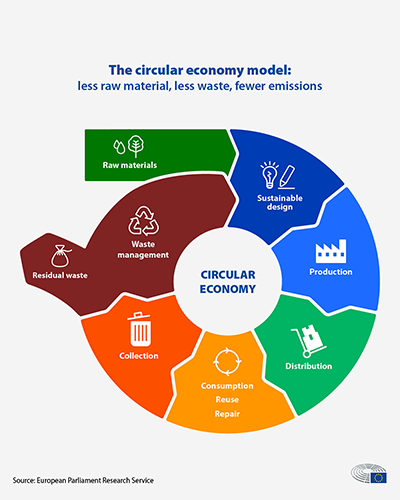
- Circular economies try to reduce waste through a number of strategies including reusing and recycling items
- I am seeking to understand the circular economy associated with raising children in Toronto
- Raw data is being collected alongside any secondary data that can be found
- Objectives:
- Quantify average savings per household that engages in this circular economy
- Estimate the number of items in key categories (clothing, toys, etc) circulating and how much has been diverted from landfill
- Understand the drivers and concerns around item sharing between households
- Consider applying learnings to other consumer groups/ communities to lower cost and increase objects’ lifespans (eg hobby communities or elderly groups)
Overview
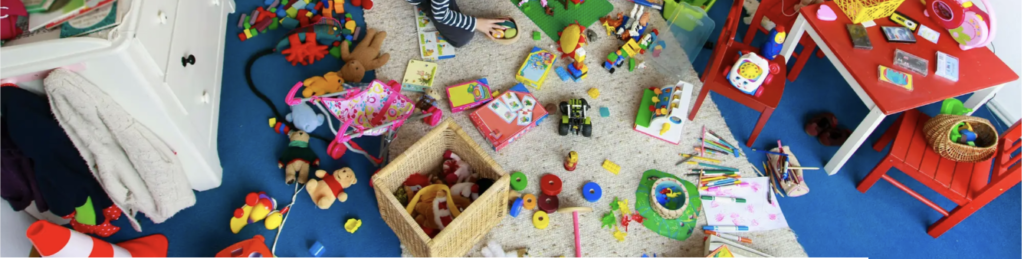
- Raising children is expensive and resource heavy, many “things” are needed but are often only used for a brief period (clothing developmental toys, etc.)
- In the City of Toronto, there are roughly 418,00 family households with children of various ages (StatCan)
- I have personally engaged in and benefitted from an extremely active, yet informal, circular economy leading to thousands of dollars saved and many items diverted from land fill
- I want to understand how much can an average household can save from engaging in this circular economy? What are the mechanics that allow this flow of items?
- Equally, what can we learn from this circular economy that could be applied to other communities to help save money and reduce waste?
- Finally, what are the risks to this circular economy and would it benefit from being formalized?
What is a Circular Economy?
A circular economy is an economic model that replaces the traditional “take-make-dispose” linear system with a closed-loop system designed to eliminate waste while keeping products and materials in use for as long as possible.
The circular economy tackles climate change and other global challenges, like biodiversity loss, waste, and pollution, by decoupling economic activity from the consumption of finite resources (source).
Testing the Water
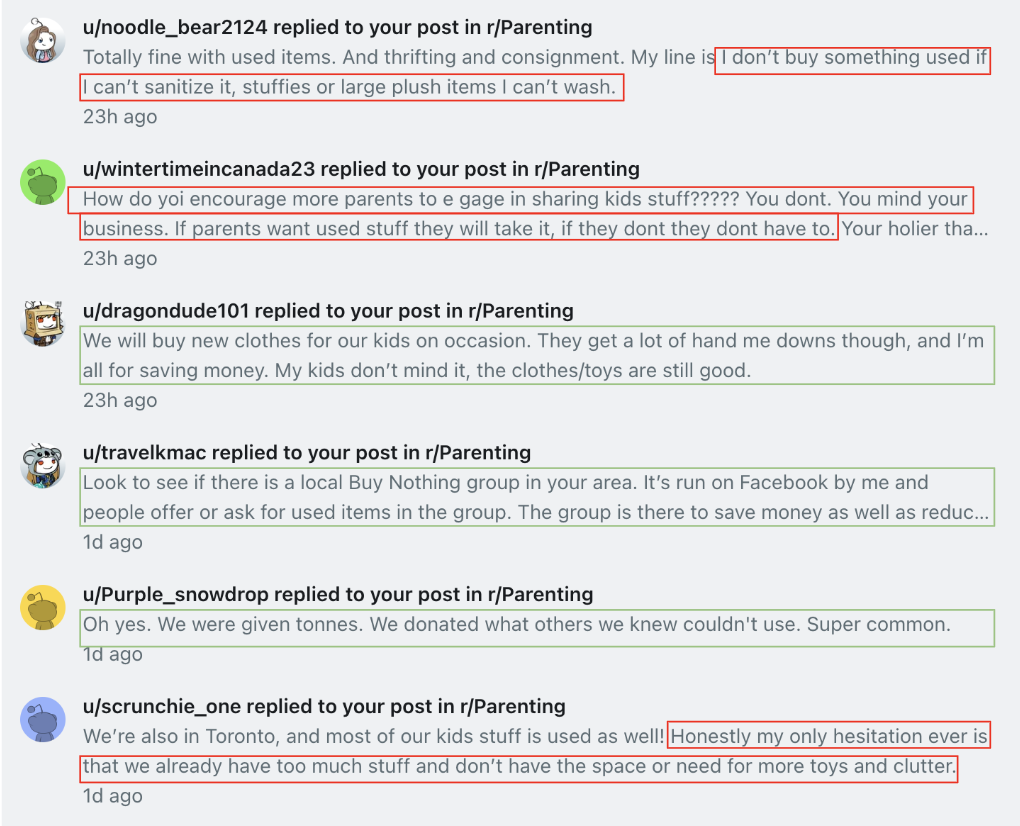
To gain some quick exposure before designing a survey, I posted to the r/Parenting channel in Reddit asking a few questions:
- Do you accepted hand-me-downs for your kids?
- Do you share your kids’ things when you no longer need them?
- What holds you back from not sharing more?
- How could we encourage more people to share?
This generated a number of responses that painted an interesting picture of both why people do and do not share or accept hand-me-downs.
Initial Feedback
Positive Sentiment
AI Analysis: Overall, the sentiment across these statements is overwhelmingly positive, practical, and community-oriented, driven by financial mindfulness and resourcefulness. Contributors express deep gratitude and relief regarding the support received from friends, families, and neighborhood gifting groups like Buy Nothing and Freecycle. While the reliance on second-hand goods stems from a pragmatic concern over high retail prices and rapid childhood growth, this necessity is met with satisfaction rather than frustration. Participants take evident pride in saving money and finding items in good, hygienic condition to reuse. Moreover, there is a strong, reciprocal sense of altruism, as parents feel genuine joy and responsibility in paying it forward by regifting outgrown items to other families. Ultimately, the shared perspective frames the second-hand lifestyle not merely as a budget tactic, but as a fulfilling, cooperative community cycle.
Negative Sentiment
AI Analysis: The overall sentiment across these points is cautious, guarded, and pragmatic, reflecting a strong emphasis on personal boundaries and risk management. Contributors voice noticeable skepticism toward unsolicited advocacy, asserting that accepting second-hand goods is a strictly personal choice that should not be forced onto other parents. Safety and hygiene emerge as primary concerns, highlighted by hesitation around unsanitizable materials, clutter, and potential product recalls on critical gear like cribs. Additionally, the statements reveal a critical awareness of social friction, citing cultural stigmas and pride that lead some families to associate hand-me-downs with charity or poverty. There is also a candid acknowledgment of self-interest, noting that parents frequently withhold quality items to save them for future siblings. In essence, the tone balances realistic logistical worries with a firm stance on respecting individual preferences and boundaries.
Designing the Survey
Clearly the responses show both positivity and cautiousness around the sharing of hand-me-downs. These initial findings highlight a few keys themes that can be further investigated through surveys and 1:1 conversations with parents.
Key themes to focus on:
- Financial impact
- Community building
- Risk factors (eg. product recalls, sanitation, etc.)
- Cultural factors
Survey:
The survey will have 4 sections to investigate these themes:
1: Estimating Past Sharing & Receiving Volume
2: Motivations and Drivers
3: Barriers, Boundaries, and Logistical Limits
4: Social Dynamics and Potential Solutions
Life Cycle Assessment
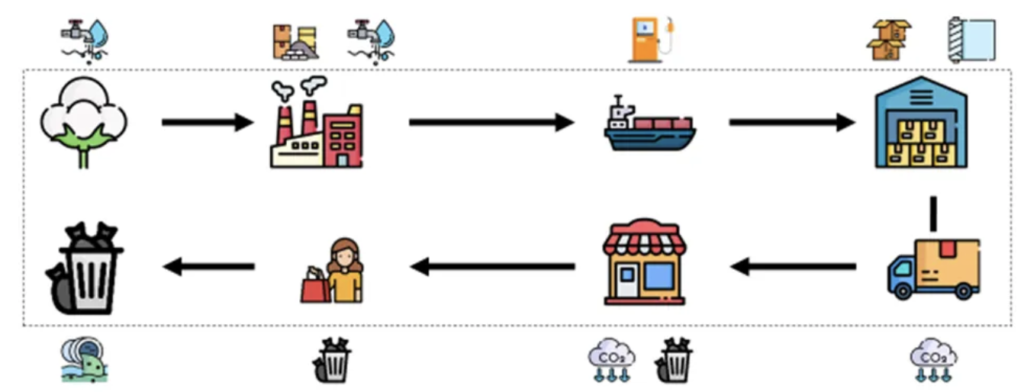
Source: https://medium.com/data-science/what-is-a-life-cycle-assessment-lca-e32a5078483a
The life cycle assessment aims to identify and quantify a product’s environmental impacts across its entire life, from “cradle to grave” the inputs and emissions are tracked along the value chain.
Almost every product has a unique life cycle between the origins of the materials to the production location, point of sale and usage. Within this life cycle there are a number of variables to consider:
- Raw materials
- Carbon dioxide emissions
- Water usage
- Transport
- Overall energy consumption
- Disposal
- And more
Example Life Cycle Assessment
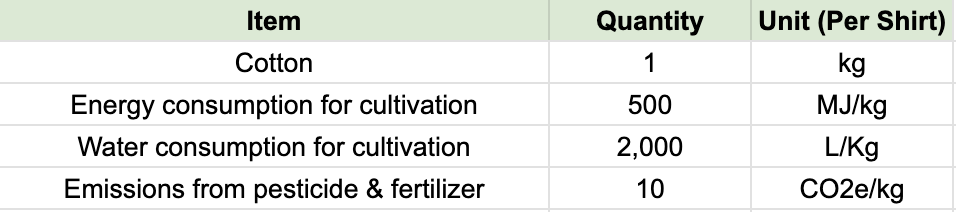
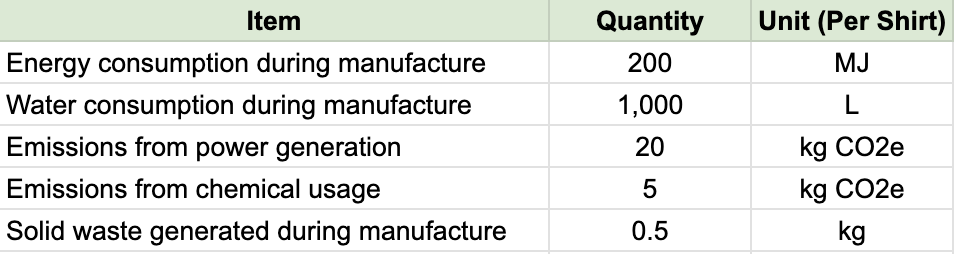
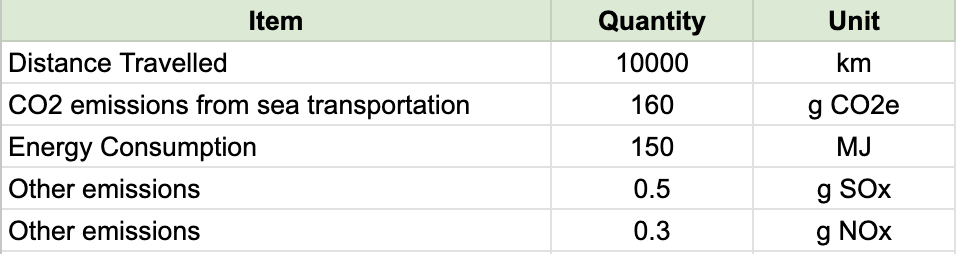
A standard item of children’s clothing can be assessed using a series of assumptions about the product and manufacture. In this example, the item has been produced in India and transported to Canada.
Please note the below is a high level example based on this source and a traditional assessment would be in greater detail.
Raw Materials
Manufacture
Transportation
Usage & Disposal
If the product were to be used for 6 months before being outgrown:
- Energy consumption for washing and drying: 25 MJ
- Water consumption for washing and drying: 125 L
- Emissions from electricity generation: 2.5 kg CO2e
The t-shirt is disposed of in a landfill in Canada.
- Emissions from decomposition: 5 kg CO2e/t-shirt
Impact Assessment
- Energy consumption:
- 850MJ
- Greenhouse gas emissions:
- 42.5 kg CO2e
- Water consumption:
- 3,000 L
- Solid waste:
- 500g
- Air pollution
- 0.5 g of SOx and 0.3 g of NOx emissions
Next Steps
- Distribute survey and hold 1:1 interviews with parents
- Analyze data for trends in how people engage with the circular economy
- Conduct life cycle assessments on top items mentioned in parent responses
- Estimate average savings per household when engaging in circular economy
- Quantify volume of items being circulated at any one time
- Determine potential next steps such as seeking to expand engagement or applying mechanisms to other groups